Back to news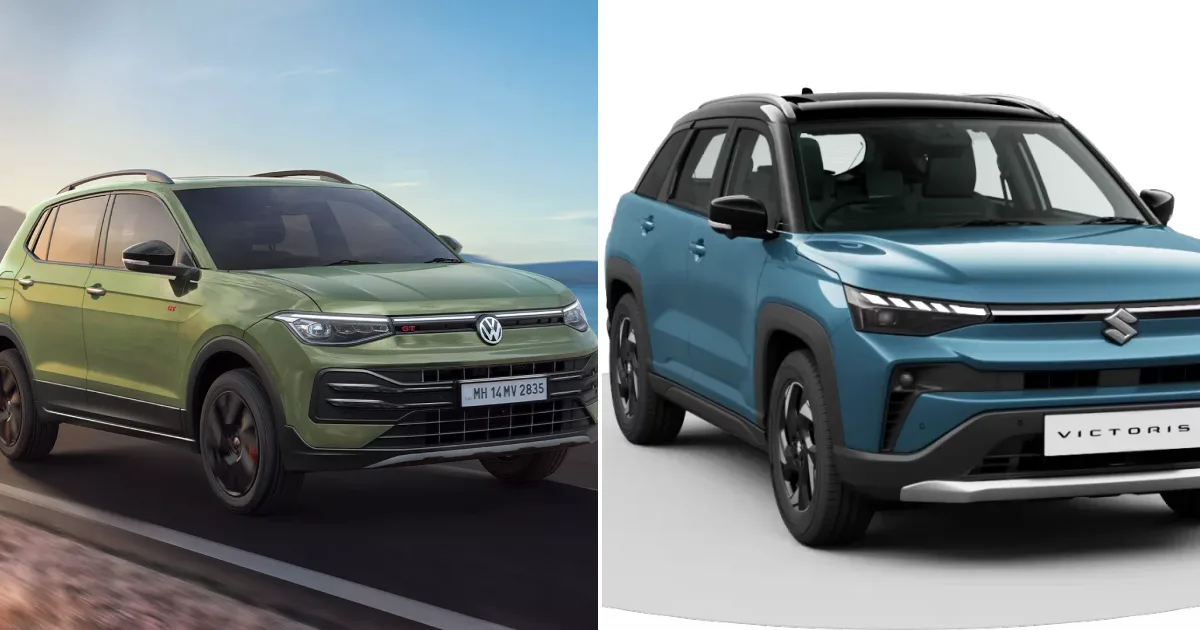
The Indian automotive landscape is bustling with compelling SUV options, and among them, the Maruti Suzuki Victoris and Volkswagen Taigun stand out as popular choices. Both models cater to the growing demand for SUVs, but they approach the segment with distinct philosophies, making a direct comparison essential for prospective buyers.
Starting with price positioning, the Maruti Suzuki Victoris offers a broader entry point into the SUV segment. Its ex-showroom price range begins at ₹1,049,900 and extends up to ₹1,998,900. In contrast, the Volkswagen Taigun commences at a slightly higher ex-showroom price of ₹1,100,000, with its range topping out at ₹1,929,000. This indicates that while both models compete in a similar premium bracket at their higher ends, the Victoris provides a more accessible starting price for buyers looking for value.
Both the Victoris and Taigun are categorized as SUVs, fitting well within the popular body type. The Taigun is specifically described as a compact SUV built on the MQB-A0-IN platform, and it also highlights features like GT Line styling and Level 2 ADAS in its description, suggesting a focus on modern design and advanced driver assistance systems.
A significant differentiator lies in their fuel and transmission options. The Maruti Suzuki Victoris offers a versatile choice of both Petrol and CNG fuel types, catering to a wider spectrum of buyer preferences, especially those prioritizing lower running costs with CNG. For transmission, the Victoris provides both Manual and Automatic options. The Volkswagen Taigun, on the other hand, is exclusively available with a Petrol engine, also offering both Manual and Automatic transmission choices. This makes the Victoris a more flexible option for buyers considering alternative fuels.
Variant availability also presents a clear distinction. The Maruti Suzuki Victoris boasts an impressive 35 variants, offering a vast array of choices in terms of features, trim levels, and price points. The Volkswagen Taigun, while comprehensive, offers 10 variants. This difference in variant count means the Victoris provides a much finer degree of customization and choice for buyers to match their specific needs and budgets.
So, which one is for whom? The Maruti Suzuki Victoris emerges as an excellent choice for buyers prioritizing a lower entry price, the flexibility of a CNG fuel option, and a wide array of variants to choose from. Its extensive variant list ensures there's likely a Victoris configuration for nearly every budget and feature requirement within its range. The Volkswagen Taigun, with its petrol-only powertrain and specific mention of advanced features like Level 2 ADAS, would appeal to buyers who prefer a premium compact SUV experience, are content with a petrol engine, and potentially value the brand's specific design language and technological offerings.
For current prices and full variant details of both the Maruti Suzuki Victoris and Volkswagen Taigun, prospective buyers can always refer to their dedicated model pages on DriveQ.
Comparison
Maruti Suzuki Victoris vs Volkswagen Taigun: A DriveQ SUV Comparison
DriveQ Editorial
Published 5 October 20263 min read
Explore a detailed comparison of the Maruti Suzuki Victoris and Volkswagen Taigun, two prominent SUVs in the Indian market. We analyze their price positioning, fuel and transmission options, and variant availability to help you make an informed choice.